






Contents
In an eggshell...
- PID is an infection of the upper reproductive organs: the womb, fallopian tubes and ovaries
- Symptoms range from pelvic pain and unusual discharge to nothing noticeable at all
- It's treated with a course of prescription antibiotics, and doctors usually start treatment before every test result is back
- Repeat or untreated episodes can scar the fallopian tubes, which in turn might affect your fertility
If you've been googling ‘reason for pelvic pain’ or researching down a Reddit rabbit hole for the same at 2AM- we’ve got you.
Is it your period? A UTI? Something you ate, or something more?
And if it's persistent, it's better to have the right information or book a GP appointment than be left with more questions.
One of the causes of persistent pelvic pain can be pelvic inflammatory disease.
So we sat down with our medical team to bring you all the details on what it actually is, how it gets diagnosed, and what it does (and doesn't) mean for your fertility.
What Is Pelvic Inflammatory Disease?
Pelvic inflammatory disease refers to an infection in the upper part of your reproductive tract. That covers the womb (endometritis), the fallopian tubes (salpingitis), the ovaries, and the tissue around them.
The infection almost always starts lower down, around the vagina or cervix, and works its way up.
The symptoms of PID usually involve pain and a fever over a day or two. Because these symptoms are not very specific to the pelvis, there are chances that it can be dismissed as a routine fever.
It can also easily sit quietly for weeks- showing up as discharge that's a little different or bleeding that's slightly off-pattern. This is also one of the reasons why many cases get picked up late.
What Causes Pelvic Inflammatory Disease?
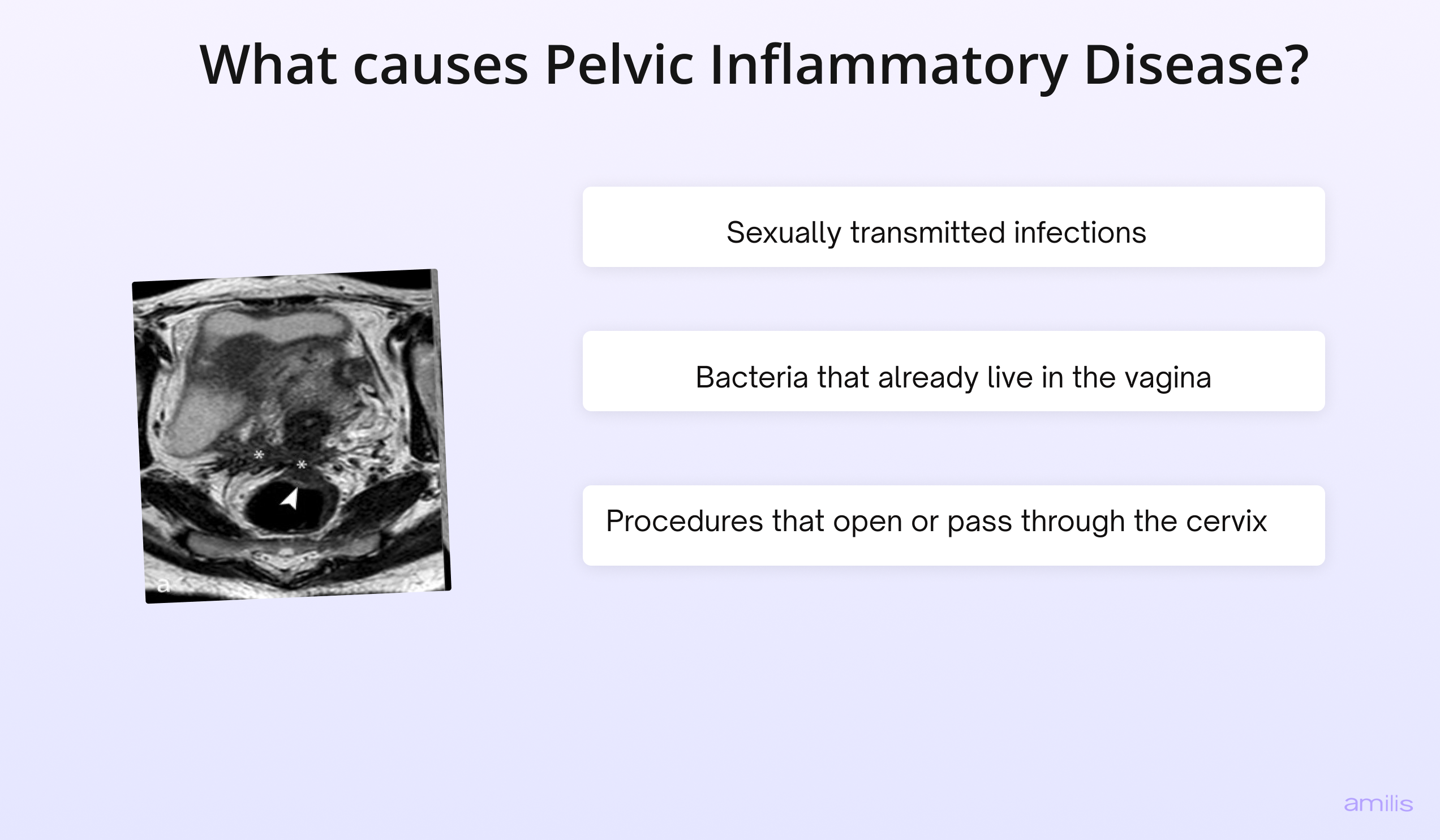
Pelvic inflammatory disease is usually caused by bacteria getting in from your vagina or cervix up into your womb, fallopian tubes and ovaries, which is somewhere they aren't meant to be.
Those bacteria usually arrive from STIs, bacteria that live in the vagina or any procedure that briefly opens the cervix.
Here's a quick breakdown to help you understand it better:
Sexually transmitted infections
Chlamydia and gonorrhoea are two of the most commonly identified causes of PID. Mycoplasma genitalium is another sexually transmitted infection that has also been linked to PID.
The tricky part with these is that all three infections can be present without obvious symptoms.
You may feel completely well while the infection is quietly travelling upwards and causing inflammation.
This is one reason PID can sometimes develop silently, and also why STI testing is usually an important part of a PID assessment, even if you do not have typical STI symptoms.
Bacteria that already live in the vagina
Turns out, not every case of PID is caused by an STI.
The vagina naturally contains a mixture of bacteria. Sometimes, bacteria that are normally harmless in small amounts can move upwards into the reproductive tract and contribute to infection.
This may include anaerobic bacteria, which are bacteria that thrive in environments with little or no oxygen, as well as bacteria associated with bacterial vaginosis. Other bacteria from the vagina or bowel may also be involved.
So, if your STI tests are negative, that might not really mean that PID has been ruled out.
Instead, your doctor will consider the full picture, including your symptoms, examination and any other test results.
Also, bacterial vaginosis is not the same as PID. However, changes in vaginal bacteria associated with BV may make it easier for certain bacteria to travel upwards.
Procedures that open or pass through the cervix
The cervix usually acts as a protective barrier between the vagina and the upper reproductive organs. When it has recently been opened or passed through during a procedure, bacteria may have a slightly easier route upwards.

Again, this doesn’t mean these procedures usually cause PID. The overall risk remains low, and it generally settles once this short-term window has passed.
Your healthcare professional may give you specific symptoms to look out for after a procedure, such as increasing pelvic pain, fever, unusual discharge or feeling unwell.
So, can you get PID without an STI?
Yes, you can get Pelvic inflammatory disease. without an STI.
An STI is a common cause and is always worth testing for, but it is not the only explanation. PID can also involve bacteria that already live in the vagina or bacteria introduced around a recent pregnancy-related or gynaecological procedure.
A negative STI result does not rule out PID, and having PID does not automatically mean that you or your partner has done anything wrong.
If you are experiencing pelvic pain, unusual discharge, bleeding between periods, pain during sex or fever, it is worth speaking to a doctor rather than trying to identify the cause yourself.
This is also why early treatment matters, because it can help reduce the chance of complications, including scarring around the fallopian tubes.
What Are the Symptoms of Pelvic Inflammatory Disease?
The thing with pelvic inflammatory disease is that the symptoms can vary and look very different from person to person.
Another issue that might also delay its diagnosis is the fact that the symptoms can overlap with a lot of other conditions.
For instance, you may notice:
- A dull ache or sharper pain low in your tummy or pelvis.
- Pain deep inside during sex, or bleeding afterwards.
- Vaginal discharge that looks, feels or smells different from usual.
- Bleeding between periods.
- Periods that suddenly become heavier or more painful.
- Burning or pain when you wee.
- Fever, chills or feeling generally unwell.
- Nausea, vomiting or lower back pain.
And the thing with PID is that you don't need all of it to confirm a diagnosis, but a single symptom on its own cannot confirm it either.
Because other conditions such as Endometriosis, ovarian cysts, UTIs and other vaginal infections can all cause similar symptoms, it's always better to keep track of your symptoms and also get it checked by a GP at the earliest.
Can PID Cause Bloating or Back Pain?
It is possible for PID to cause bloating or back pain alongside pelvic pain.
But because these symptoms are more generic and not specifically related to PID, if the pain keeps returning or is getting worse, or is starting to interfere with your everyday life, that's enough reason to get it checked by your GP.
Can PID Delay Your Period?
PID is more commonly linked to bleeding between periods or heavier, more painful periods than a missed period.
A late period can happen for many reasons, including stress, weight changes, hormonal conditions and pregnancy.
How Is Pelvic Inflammatory Disease Diagnosed?
A diagnosis of pelvic inflammatory disease cannot be made based on symptoms. It requires data such as your menstrual cycle, sexual health history, previous infections, and any recent procedures or pregnancy. PID is usually diagnosed from a collection of all this data rather than a single test.
You may be offered:
- STI testing, including chlamydia and gonorrhoea
- Vaginal or cervical swabs
- Blood or urine tests
- A pelvic examination to check for tenderness
- And sometimes, an ultrasound
Because delaying treatment can increase the risk of complications, doctors may start antibiotics when PID is suspected rather than wait for all the results to come back.
It is important to know that this is a way of treating the infection promptly while the test results are being processed
Can an Ultrasound Detect PID?
Sometimes, a pelvic or transvaginal ultrasound may show fluid in the fallopian tubes, inflammation around reproductive organs or a tubo-ovarian abscess. It can also help your doctor look for other possible causes of pelvic pain.
But it cannot pick up mild or early PID. For instance, if the cause is sexually transmitted, an ultrasound wouldn't help. You would need a blood test or a urine test to detect infections such as chlamydia.
How Is Pelvic Inflammatory Disease Treated?
PID can usually be treated with antibiotics, especially when it is diagnosed early.
You will often be prescribed a combination of antibiotics because several types of bacteria may be involved at once. The exact treatment depends on your symptoms, test results, allergies, whether you could be pregnant and how unwell you are.
Treatment commonly lasts around 14 days, although the exact medicines and duration can vary.
Most people are treated at home. Hospital care comes into it if you're very unwell, pregnant, unable to keep tablets down, not responding to oral antibiotics, or if an abscess is found.
Can PID Be Cured?
Yes, an active infection of PID can usually be cleared with the right antibiotics. But any damage caused before treatment began, such as scarring or adhesions formed around or near the fallopian tubes, cannot be cured with antibiotics.
In such cases, there might be a different treatment path, and it is also an emphasis as to why it is worth getting checked early on when your symptoms are mild.
Can Pelvic Inflammatory Disease Affect My Fertility?
Yes, PID can affect fertility, but having PID does not mean that you will definitely have difficulty conceiving.
Inflammation can cause scarring around the fallopian tubes. If a tube becomes narrowed or blocked, it can be harder for the egg and sperm to meet.
Tubal scarring can also increase the risk of an ectopic pregnancy, where a fertilised egg implants outside the womb.
Your risk depends on several things, including:
- How severe the infection was.
- How quickly treatment began.
- Whether your fallopian tubes were affected.
- Whether you have had PID more than once.
Repeat episodes are associated with a higher risk of fertility problems and chronic pelvic pain than a single treated episode
But it’s also important not to assume the worst. Most people who have had one episode of PID go on to conceive without fertility treatment.
If you are trying to conceive after PID and pregnancy is not happening as expected, it’s best to speak to a doctor.
They may suggest fertility tests, including an assessment of your fallopian tubes, so you can understand what is going on and what the right next steps are.
📚 Also read: What is an AMH test?
PID and Egg Freezing: What You Need to Know
We know for a fact that PID can affect your fertility, but if you had an infection recently or have just recovered from one- and are planning your egg freezing cycle- how exactly does it affect it?
So, let’s make it practical.
If PID has caused scarring or blockage in the fallopian tubes, this could affect natural conception, as it disrupts the part where the egg and sperm meet.
But egg freezing works differently. During egg retrieval, eggs are collected directly from the ovaries. If you decide to use them in the future, fertilisation takes place in a laboratory through IVF. The fallopian tubes are not needed for that part of the process.
This means that a history of PID does not automatically rule out egg freezing. PID also does not affect your egg count. Its main effect is more likely to be on the fallopian tubes rather than the number of eggs in your ovaries.
What does this mean in practice?
This is worth keeping in mind before you start your consultation for an egg freezing cycle:
- An active pelvic infection needs to be treated before any transvaginal procedure, including egg retrieval.
- Tell your fertility doctor if you have had PID before, even if it happened years ago, so they can factor it into your patient profile or medical history.
- If you're trying to conceive naturally after PID, a tubal patency test (a HyCoSy or an HSG) is often part of the fertility workup
- A history of PID also does not automatically mean that you need fertility treatment or that egg freezing will not be suitable for you.
Get Expert Gynaecological Care in the UK, via Amilis
Pelvic Inflammatory Disease is treatable. But having the right resource at the right time is what matters the most for effective treatment.
That's why we at Amilis are trying to make this mission happen for anyone who needs it in the UK.
Here's how Amilis can support you:
- Book a free consultation with a fertility doctor to talk through pelvic pain, a past PID diagnosis, or how any of it might affect your health
- Speak to a fertility doctor about which tests are worth doing for your situation, from ovarian reserve testing to tubal checks
- Book a free consultation with a clinic and get guidance on your next step, whetherIt's egg freezing or fertility testing
And if you're still confused about what to do next, book a free call with us or take our personalised quiz. Our founders dedicate time every week to speak with you personally and to help you understand your reproductive health better.
We're making reproductive healthcare accessible and affordable in the UK, one day at a time 💪🏻
Frequently Asked Questions
What does pelvic inflammatory disease mean?
It means an infection and inflammation affecting the upper reproductive organs, including the womb, fallopian tubes, ovaries and the tissues around them.
Can you get PID without an STI?
Yes. Chlamydia and gonorrhoea are common causes, but PID can also involve bacteria that normally live in the vagina, including those linked to bacterial vaginosis.
How do I know if I have pelvic inflammatory disease?
Symptoms alone cannot confirm PID. A doctor will usually consider your symptoms and medical history alongside a pelvic examination, STI tests, a pregnancy test and, sometimes, an ultrasound.
Can a pelvic ultrasound see PID?
An ultrasound may show signs such as fluid in the fallopian tubes or a tubo-ovarian abscess. However, a normal scan does not rule out PID, particularly if the infection is mild or early.
What antibiotics treat PID?
PID is usually treated with a combination of prescription antibiotics, often for around 14 days. The exact treatment depends on your symptoms, test results, allergies and whether you could be pregnant.
Can PID come back?
Yes. PID can return if a new infection develops or a partner was not tested and treated. Repeated episodes increase the risk of tubal scarring, so partner treatment is an important part of care.
Can men get PID?
Men do not develop PID because it affects the female upper reproductive tract. However, they can carry infections such as chlamydia or gonorrhoea without symptoms and pass them on, which is why partner testing may be recommended.
Can PID affect fertility?
It can, mainly if inflammation causes scarring around the fallopian tubes. However, most people who have had one treated episode go on to conceive without fertility treatment.
Can I still freeze my eggs after PID?
In most cases, yes. Egg freezing collects eggs directly from the ovaries, so it does not depend on the fallopian tubes. Any active infection needs to be treated first, and your fertility doctor should know about your history.



.png)

