.png)



In an eggshell...
- In women's health, a diagnosis is usually reached across several appointments rather than just one
- This is because scans, blood tests, symptom history and treatment response arrive across different appointments, often from different providers.
- Current tools usually leave that data spread across separate systems, so the clinician sees only part of the picture.
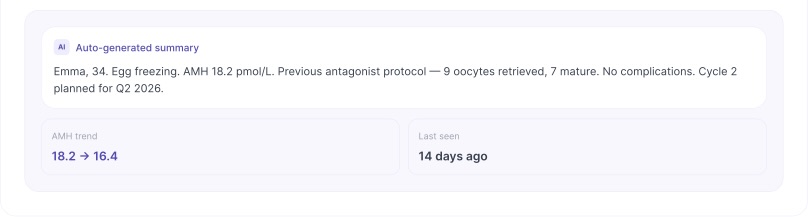
- Amilis OS is built so the record travels with the patient, giving clinicians the full history and the tools to structure her journey from appointment to billing.
In 2024, Endometriosis UK's diagnosis report put the average time to an endometriosis diagnosis in the UK at 8 years and 10 months.
Imagine waiting that long for a diagnosis while the symptoms get worse.
In the same survey of 4,371 people with a confirmed diagnosis, 47% had seen their GP ten or more times before being diagnosed, and 20% had seen a gynaecologist ten or more times.
These numbers speak to a larger problem than just the wait for diagnosis.
It is also a data problem. If you move from one GP to another, you repeat the same history each time, and nobody is looking at it as one continuous journey.
This is part of the problem we are solving with Amilis OS. In our conversations with clinicians and gynaecologists, this issue has come up more times than we can count.
So here is our take on how we're fixing it.
Issue #1: Patient data doesn’t move between clinicians
Even within a clinic, the handover between two doctors can break the thread.
This came up often in our beta testing. A fertility clinic operations lead described what happens when one consultant covers another's list during leave. Their current system stores documents without any real structure, so there is no folder holding a patient's clinic letters or follicular charts in one place:
"There aren't clinic letters or any folders. So you have to trace through everything, and it could be lots of them, because Dr [A] sees the patient every two days, Dr [B] sees the patient once a week. So it's very hard to keep track of everything."
If Dr [B] is covering for Dr [A], they should have the whole patient journey in front of them instead of piecing it together from scattered files.
Between clinics, the gap widens. If a patient moves to a new provider, or starts a stimulation cycle somewhere else, there is no system in place that connects her data from one clinic to the other.
Referrals carry the same risk. When a gynaecologist refers on to fertility, or a fertility clinic refers to endocrinology, the receiving clinician usually gets a letter without the data behind it.
This is the specific gap Amilis OS is being built to close across gynaecology, so that referrals move with their evidence attached and women are not left restarting their care at each new door.
🩺 Facing the same issue with your private practice or clinic?
Book a free demo of Amilis OS and see what a single continuous patient record looks like in practice.
Issue #2: Results live outside the record
In women's health pathways, data is rarely generated by a single clinic.
Bloods go to an external lab, scans to an imaging provider, medication through a pharmacy partner. Each returns results on its own timeline, and into a different inbox.
In one beta testing session, a clinic described nurses plotting blood and scan results into a Google Drive spreadsheet, because their clinical system had no way to chart values over a cycle.
This not only results in manual work, but there is also no system in place for reminders.
A blood test taken today might return results two days later, and tracking that down in a spreadsheet with ten other patients booked in is hard on whoever has to read it.
And worse? And a result that never gets followed up never gets invoiced either, so it surfaces only in a financial audit.
Issue #3: The outcome is never tracked
The most expensive continuity gap in women's health is at the end of the pathway.
In UK fertility care, a patient who conceives is typically discharged to NHS maternity care at around 12 weeks. From that point, the clinic that treated her often has no route to the outcome.
One clinic lead told us they need a way to track patients after discharge, specifically to capture live birth data, because otherwise their own success rates are estimates.
The same clinic described having to manually audit thousands of patient records to work out treatment efficacy, because their marketing system tracks the funnel and their clinical system stores the notes, and neither can answer "what happened to the patient we treated."
A clinic that cannot see its own outcomes by protocol, by patient profile, or by consultant cannot improve any of them over time. The loss lands on both ends: the clinic, and the quality of care the patient receives.
What cervical cancer screening shows about the same gap
Cervical cancer screening shows the same gap clearly.
This Substack article makes the same argument about what happens when results are never followed up, or never travel between facilities:
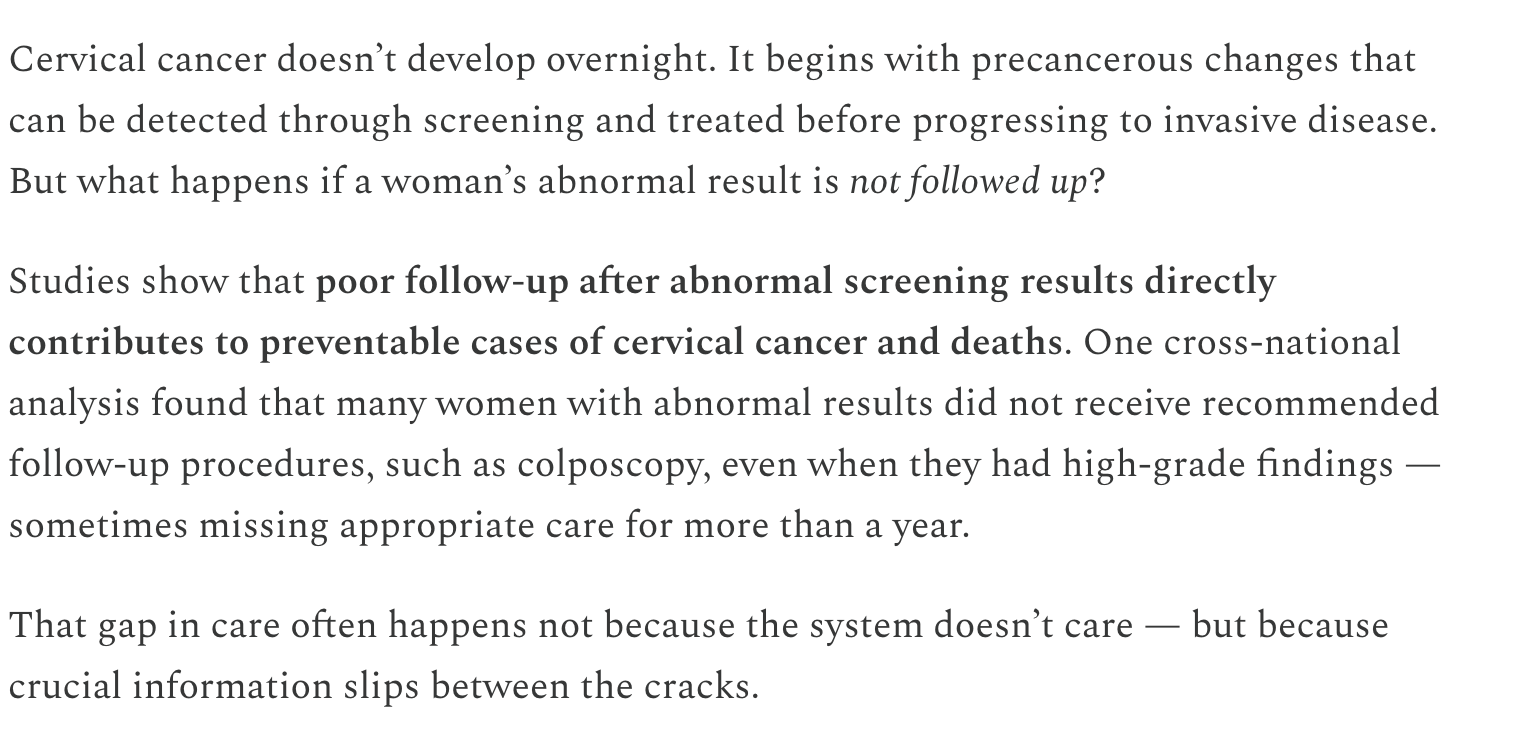
The same applies well beyond screening. Wherever follow-up is missed or data does not travel between clinics, diagnosis gets delayed and symptoms get worse while it does.
Continuity is a data structure problem before it is a software problem
Buying a system that stores everything in one place is not the same as having continuity.
What matters is whether the data is stored in a form that another system, another clinician, or an audit can read.
Two things came out of our beta sessions on this.
The first is coding. A clinician building his own practice told us the differentiator he wanted was structured, coded patient data instead of free text, because that is what makes auditing, tracking a patient's history and summarising notes reliable.
The second is portability and sharing. Regardless of the type of practice you run, the data you store has to meet the regional standards for healthcare data or the standards other systems can read. And if you're referring your patient to another clinician or if you need to share records with the clinic, the process should be easy, not add admin work to your plate.
What Amilis OS is built to connect
Amilis OS holds scheduling, clinical records, diagnostics, billing and follow-up in one system, designed around how gynaecology and fertility clinics actually work.
In practice, that means a few specific things:
- One continuous patient record. Consultations, results, medications and outcomes attach to the patient, not to whoever happened to be in the room, so the next clinician opens a history instead of a search.
- Visual tracking for the pathways that need it. Stimulation cycles, hormonal treatment, early pregnancy monitoring and male partner workflows are tracked as a continuous series, so a clinician can see how a patient responded across the whole pathway.
- Results routed to a named person. Partner lab and imaging results land against the patient record, with follow-up assigned to a person and a date instead of to somebody's memory.
- Structured, coded data from the first appointment. Intake forms populate the record, changes are logged, and the record stays readable by another system later.
- The financial trail attached to the clinical one. A scan that has been delivered and not invoiced shows up as an exception, months before an audit would find it.
The effect compounds. A clinic running on one connected record produces cleaner data, cleaner data makes outcomes visible, and visible outcomes are what let a clinic improve care over time.
In women's health, where the diagnosis is built over months and across providers, that continuity is what better care depends on.
Want to see how Amilis OS keeps a patient's record continuous across appointments, clinicians and partners? Book a free demo, and we'll walk you through it with your own workflow.