

Contents
- What is the vaginal microbiome?
- What does a healthy vaginal microbiome look like?
- What is vaginal dysbiosis?
- How is the vaginal microbiome tested?
- Can you take a vaginal microbiome test at home?
- Is a vaginal microbiome test the same as a BV test?
- How is the vaginal microbiome connected to fertility?
- Could the vaginal microbiome affect IVF or implantation?
- Who might be offered vaginal microbiome testing?
- What happens after a microbiome test?
- Is there anything you can do to support vaginal health?
- Where Amilis comes in
In an eggshell...
- The vaginal microbiome refers to the community of microorganisms living in the vagina.
- Many healthy vaginal microbiomes contain high levels of bacteria called Lactobacillus.
- Vaginal microbiome testing is not a routine fertility test for everyone. A doctor can help you work out whether it could be useful in your situation.
You may have heard “vaginal microbiome” as chatter on social media, or come across it while researching.
Or you might be seeing this for the first time and thinking, “wait… what’s that?”
Or you’ve met with a fertility doctor, and this has come up during one of your conversations.
Either way, we’re here to tell you that it is completely fair to have questions.
In fact, let’s start with the most common ones.
What is the vaginal microbiome?
And could it really affect your chances of becoming pregnant?
Well, here’s the deal. The vaginal microbiome is a growing area of reproductive-health research.
It may be linked to fertility, implantation and early pregnancy, but researchers are still working out exactly how.
So let’s take it step by step and really understand what it is and how it can affect your fertility.
What is the vaginal microbiome?
The vaginal microbiome is the community of microorganisms that naturally live in and around the vagina.
We really meant it when we said community, by the way, because it includes bacteria, fungi and viruses.
The term “microbiome” describes the microorganisms themselves, as well as the way they live together and interact with your body.
And here’s the thing: the vaginal microbiome is not fixed. It can change throughout your life and may be influenced by hormonal changes, your menstrual cycle, pregnancy, sexual activity, antibiotics, contraception and vaginal products.
And if you’ve ever heard the phrase vaginal flora- it pretty much means the same thing.
What does a healthy vaginal microbiome look like?
Many healthy vaginal microbiomes contain a high proportion of bacteria from the Lactobacillus family.
These bacteria produce lactic acid, which helps keep the vaginal environment acidic. They also produce other substances that can make it harder for some potentially harmful microorganisms to grow.
If you were to take a vaginal microbiome test, you might see individual species mentioned, including Lactobacillus crispatus, Lactobacillus iners, Lactobacillus gasseri and Lactobacillus jensenii.
But it’s important to know that a healthy vaginal microbiome can look slightly different from person to person.
Finding a particular species does not automatically confirm that everything is healthy, and neither does it automatically mean that something is wrong.
At the end of the day, your symptoms, medical history, fertility diagnosis and the type of test used all matter.
What is vaginal dysbiosis?
Dysbiosis is the medical term for a change in the usual balance of microorganisms. In the vagina, this may involve fewer Lactobacillus bacteria and a greater presence of other types of bacteria.
Dysbiosis is often discussed in relation to bacterial vaginosis, or BV.
BV is a common vaginal condition that can cause a fishy smell, thin greyish-white discharge or irritation. Some people have BV without noticing any symptoms.
If you’re trying to conceive and have symptoms of BV, it’s still worth speaking to a doctor. BV is common and treatable, and research has explored links between vaginal dysbiosis and fertility treatment outcomes—but having BV does not mean you cannot become pregnant.
How is the vaginal microbiome tested?
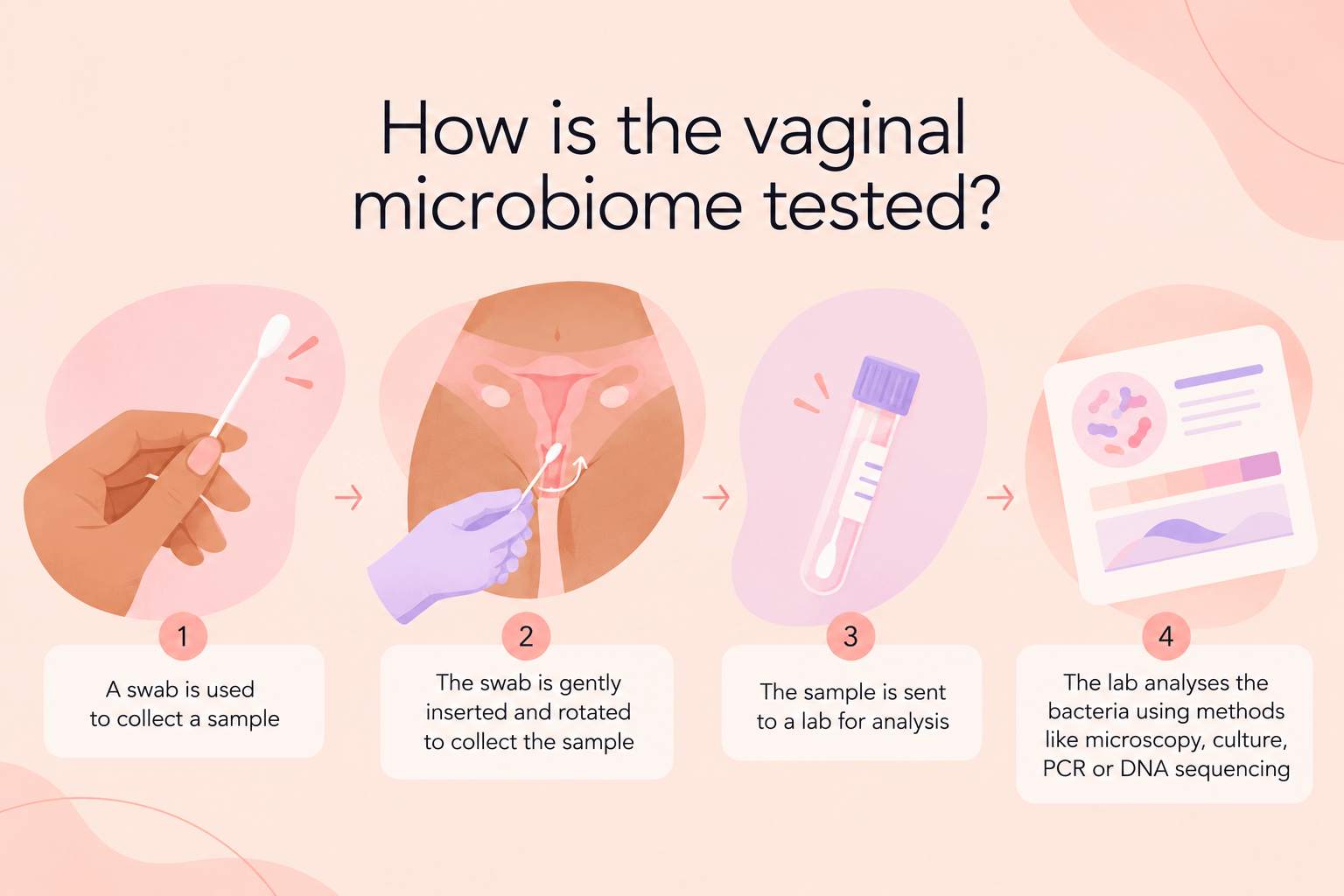
Most vaginal microbiome tests use a swab to collect a sample.
A doctor, nurse or fertility specialist can collect the sample during an appointment.
The swab is gently inserted into the vagina and rotated to collect the sample.
A heads-up from us: It may feel slightly uncomfortable, but it should not usually be painful.
Some companies also offer at-home vaginal microbiome test kits. These involve collecting a swab yourself and sending it to a laboratory.
The laboratory may use microscopy, culture-based testing, PCR or DNA sequencing.
But these methods do not all answer the same question.
Here’s why:
- A standard bacterial vaginosis test usually looks for signs that your symptoms and vaginal environment are consistent with BV.
- A wider microbiome test may identify more types of bacteria and estimate their relative amounts.
- You may also come across endometrial microbiome testing. This looks at the microorganisms found in the lining of the uterus, rather than the vagina.
The point is, depending on your symptoms or medical history, you may be recommended a specific type of test by your doctor.
Can you take a vaginal microbiome test at home?
Yes, At-home vaginal microbiome tests are available in the UK.
They can feel more private and convenient, especially when you are already managing multiple appointments. You may also want to see your results before deciding whether to speak to a specialist.
But an at-home test may not always give you the full clinical picture. Or you may still have to pay for a GP or specialist to chat your results through.
Different tests use different sampling methods, laboratory techniques and reporting systems. There is also no universally agreed definition of an “ideal” vaginal microbiome.
That means a detailed report may still leave you with the most important question: what does this mean for me?
This doesn’t mean that at-home microbiome testing isn’t useful. But it does mean that you would still need to have your report seen by a qualified doctor who can look at it alongside your symptoms and fertility history.
Is a vaginal microbiome test the same as a BV test?
Not necessarily. A BV test is usually designed to check whether you have bacterial vaginosis. On the other hand, a broader vaginal microbiome test looks at a wider collection of microorganisms.
The two tests can provide different kinds of information.
A BV test may be the more appropriate investigation when you have symptoms such as unusual discharge or odour.
A broader microbiome test may be discussed in a fertility setting, particularly when there are specific concerns about recurrent symptoms, implantation or inflammation.
Ultimately, the right test depends on your medical history and symptoms.
How is the vaginal microbiome connected to fertility?

Even as an embryologist, this was the part that I really nerded out about while writing the article.
Because this is also the bit where research becomes particularly interesting.
Scientists are studying whether the vaginal microbiome could influence local inflammation, the cervical environment, sperm movement, embryo implantation and early pregnancy.
However, the researchers highlighted limitations in the quality of the available studies, so these findings should be interpreted with caution.
Vaginal dysbiosis has also been linked in some studies with lower pregnancy rates, implantation difficulties and early pregnancy loss.
But-there is an important distinction here.
It’s important to remember that this isn’t a direct cause-and-effect relationship. A link between two things does not prove that one causes the other.
A change in the vaginal microbiome may be connected to another condition, infection, treatment or form of inflammation that is more relevant to fertility. It may also be one of several factors involved.
That is why you shouldn't interpret your result in isolation from everything else happening in your fertility journey.
When it’s included in your fertility workup or investigation, when warranted, it can make the most sense and help connect the dots.
Could the vaginal microbiome affect IVF or implantation?
Some studies have found better implantation or pregnancy outcomes among people undergoing IVF who have a more favourable microbiome profile.
Other studies have found weaker or conflicting results.
Some clinics may offer testing in specific situations, such as recurrent implantation failure or suspected chronic endometritis.
But it is not a definitive fertility test, and a result does not directly predict how an IVF cycle will go.
There are several reasons for this.
First, researchers use different definitions of a favourable microbiome. They also use different sample types, laboratory techniques and reporting methods. The microbiome can change over time, and people included in studies may have very different fertility diagnoses.
Second, a microbiome test also cannot measure every factor involved in IVF.
Age, egg and sperm health, ovulation, the uterus, fallopian tubes, endometriosis, fibroids, adenomyosis and many other factors may influence fertility and treatment outcomes.
So, it’s best to view a vaginal microbiome as an added test when necessary or recommended, rather than a complete fertility assessment.
Who might be offered vaginal microbiome testing?

A fertility specialist may discuss testing if you have recurrent implantation failure or suspected chronic endometritis.
Some clinics also offer it more generally before fertility treatment, or if you have persistent or recurrent vaginal symptoms. Here’s a quick overview:
- When someone has persistent or recurrent vaginal symptoms, repeated bacterial vaginosis
- They've experienced repeated implantation failure, suspected chronic endometritis or recurrent pregnancy loss.
- It may also come up when you have completed blood tests, hormone testing, and ultrasound scans- all with normal results- with no explanation for why you are struggling to conceive. Then a doctor might suggest testing the vaginal microbiome.
The HFEA says that some clinics offer microbiome testing before fertility treatment or for people with repeated implantation failure or suspected chronic endometritis. It also explains that there is currently no agreed best method for carrying out or interpreting reproductive-tract microbiome testing.
That does not mean the test will always be recommended in these situations. It means your doctor may consider whether the information could be useful in your specific case.
What happens after a microbiome test?
The next step after a microbiome test depends on the type of result and the reason the test was performed.
A doctor may discuss treatment for confirmed bacterial vaginosis or another infection. They may recommend further investigation, repeat testing or no treatment when the result does not appear clinically significant.
It is also important not to start antibiotics or supplements based only on an at-home report.
Antibiotics can cause side effects, and unnecessary use can contribute to antibiotic resistance. Probiotics may not be suitable for everyone, and different products contain different bacterial strains.
It’s also important to remember that an ‘abnormal’ microbiome result does not automatically mean treatment will improve your fertility.
The HFEA says there is currently insufficient moderate- or high-quality evidence to show that microbiome testing followed by antibiotics, probiotics, or both improves the chances of having a baby for most fertility patients.
Is there anything you can do to support vaginal health?
Honestly- there is no proven diet or supplement that guarantees a “better” vaginal microbiome or improves fertility. There are some foods that might support it.
But the best way to support your vaginal health is to avoid vaginal douching and perfumed washes, sprays and deodorants. And especially when you notice issues such as persistent discharge, itching, pain or an unusual odour- speak to a professional.
Where Amilis comes in
We know that fertility testing, or doing all the research for that journey, can quickly become overwhelming.
There are blood tests, scans, supplements, treatment options and results to interpret.
And especially in cases like these-adding a new test can leave you wondering whether it is genuinely necessary or whether you are simply missing something important.
That is exactly where Amilis comes in.
You can use Amilis to:
- Have a free chat with our team about any questions you might have
- Get matched with the right clinic or gynaecologist.
- Book free consultations with top fertility clinics in the UK and doctors.
- Explore affordable testing pathways where available (we work with clinics across the UK to bring you discounted fertility testing and egg freezing cycle packages)
You can find a fertility or gynaecology specialist through Amilis and get support before deciding whether a vaginal microbiome test is right for you.
And remember- a consultation does not mean that you have to agree to testing.
What it gives you is space to understand your options and ask what the result could actually change for your journey.
Book a free consultation with a doctor today, or reach out to our team for any questions. You’ve got this ♥️